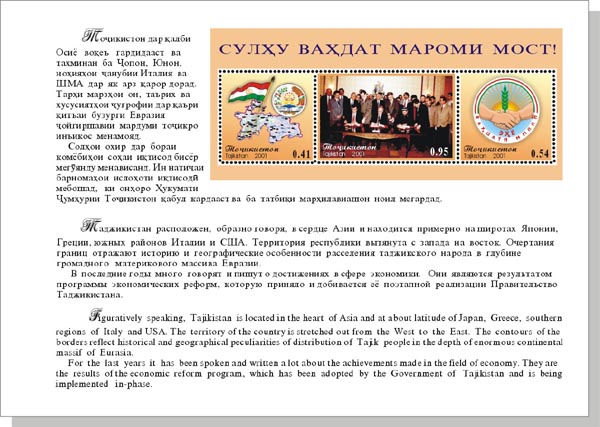
The signing of the General Agreement on the Establishment of Peace and National Accord in Tajikistan in Moscow on 27 June 1997 marked a major step in the evolution of post-Soviet Central Asia. The civil war in Tajikistan had been the most violent consequence of the Soviet breakup in that region. From its beginning, the war in Tajikistan was entwined with the long-standing war in neighboring Afghanistan, and the realignment of forces that led to agreement was equally tied to changes in that country. Hence, a final settlement of the war in would have implications for a broad region in and near the former Soviet Union.
The agreement brought to an end the armed confrontation between forces tied to the old regime and the Islamo-democratic alliance which had started in 1992. Whether the agreement will bring peace and stability to Central Asia’s weakest state, however, remains an open question. As a result of the war and the breakdown of authority, armed bands and criminal syndicates that benefited from the conflict have proliferated. In the months following the signing of the agreement, former government militias have battled their ex-allies in the capital, while former opposition armed groups have held foreign aid workers as hostages, resulting in the death of one French aid worker. Whether Tajikistan will make a transition from war to peace, or simply go from bi-polar civil war to state collapse will depend to a great extent on the support the peace agreement receives from the international community. By publishing these agreements with some explanatory material, the Central Eurasia Project of the Open Society Institute hopes to provide a resource for all those working to build such support.
Contours of the Conflict in Tajikistan
As elsewhere in the USSR, the late perestroika period saw the growth of a variety of movements in Tajikistan, including democratic, ethno-nationalist, and religious movements. The democratic movement found a home in the intelligentsia and particularly aimed against the domination of Tajikistan’s communist power structure by an elite from the oblast of Leninabad in northern Tajikistan. The ethno-nationalist movement inevitably took on Iranian or even-pan-Iranian colors, as Tajiks, while Sunni Muslims, speak a form of Persian. (The Pamiri minorities in the autonomous oblast of Gorno-Badakhshan were classified as Tajiks by the Soviet authorities but spoke Eastern Iranian languages and adhered to the Isma’ili sect of Shi’ism.) The religious movement took the form of both a revival of Islamic practice and the growth of Islamic politics, in particular through the newly established Islamic Revival Party.
Although the political conflict among these movements and the former communist rulers developed into a civil war between different regions of the country, the underlying cause of the armed conflict was not the existence of ethnic, religious, or political movements. Rather, it was the breakup of the Soviet Union that created the anarchic situation in which these groups had little alternative but to arm themselves. About half of Tajikistan’s budget, more than that of any other Soviet Republic, had depended on subsidies from Moscow, and its industries and agriculture had also relied on raw materials, energy supplies, and customers elsewhere in the Soviet system. The breakdown of that system created widespread insecurity and turned coexisting patronage networks into violent competitors for the few resources that remained.
Geopolitical effects
The war in Tajikistan provided the occasion for Russia to enunciate its new security policy, according to which the former Soviet borders (Baltics excepted) constitute the security borders of Russia, to be patrolled in partnership with the CIS. After the breakup of the USSR and the involuntary independence of the Central Asian states, international speculation grew about the potential for "Islamic fundamentalism" to spread, especially as the result of the supposed competition between the "Iranian fundamentalist" and "Turkish secular" models. Though the reality of the conflict was quite different, Tajikistan was taken as an illustration of the worst-case scenario for the whole region. Russia stationed 25,000 troops there, including 17,000 border forces and 8,000 members of a CIS "peacekeeping" force, which also included nominal contributions by Uzbekistan, Kyrgyzstan, and Kazakstan.
Talks sponsored by the UN, supported by the OSCE, and aided by a second-track dialogue process that developed out of the U.S.–Soviet Dartmouth Conference, led to the peace agreement in June 1997. While the talks had dragged on since 1994, it was the capture of Kabul by the Taliban in September 1996 that seemed dramatically to alter the pace. Russia, Iran, and the Tajik ex-mujahidin of north Afghanistan all had an interest in a stable Tajikistan, including both sides, which functioned as a rear supply base for the Afghan Tajik fighters led by Ahmad Shah Massoud. In addition, since the appointment of Yevgeny Primakov as Foreign Minister of Russia, settling civil wars in the former Soviet south seemed to become a higher priority. Indeed, Primakov’s first visit abroad as Foreign Minister was to Dushanbe.
There were, by this time, few ideological obstacles to an agreement. Both sides were exhausted and dependent on external aid, the drug trade, and other such enterprises. The state and society of Tajikistan were in no condition to withstand any ideological experiments. In addition, Iran and Russia, the most important foreign powers in the country, had developed common interests. Iran does not support the Sunni movement of Tajikistan and is instead betting on a stabilized country linked to it by Persian culture. Iran needs to preserve its cooperative relationship with Russia. Especially after the rise to power in Afghanistan of the mainly Pashtun Islamic Movement of Taliban (Islamic students) with Pakistani and Saudi support, Russia, Iran, and Uzbekistan became even more alarmed about the situation there. All were in different ways aiding the non-Pashtun (Tajik, Uzbek, and Shia Hazara) forces resisting the Taliban in north Afghanistan. Iran and Russia also had similar interests in the Caspian Sea, in limiting Western involvement in Central Asia, and in increasing their leverage over Afghanistan.
The Agreements
The June 1997 agreements provide for a modified form of power-sharing between the government and the opposition. While the current president, Emamoli Rakhmonov, retains his position and all powers, he is supposed to act in consultation with a Commission on National Reconciliation (CNR), headed by Said Abdullo Nuri, chairman of the United Tajik Opposition (UTO) and of the Islamic Revival Movement (IRM). The CNR, together with the president, oversees a variety of other measures, such as the integration of the various military forces, the disarming of some, the inclusion of fixed percentages of opposition supporters in government institutions, the reduction in size of the security forces, the legalization of banned organizations and publications, the reintegration of returning refugees and fighters, and the holding of new elections. The agreement also codifies the role of the CIS peacekeeping forces, the UN military observers, and the OSCE mission.
Strong support for the operations of the Commission on National Reconciliation, for greater inclusiveness in the government, and for revival of the Tajik economy will be vital in heading off the many obstacles that implementation of the agreement will face. In addition, years of war and privation on top of decades of the Soviet experience have left much of the population of Tajikistan politically passive. They have little access to reliable information concerning events in their own country, let alone in the world at large. There is little civil society in Tajikistan to build support for the agreement. Hence, international agencies must also support open media and other forums in which the vast majority of the people of Tajikistan, who belong to none of the warring groups, might articulate their support for peace and stability. The Open Society Institute’s Central Eurasia Project will be working with partners to identify projects in all of these areas to which it can contribute. Those in other fields should similarly exert themselves. Successful implementation of the precarious accords could change the lives of millions of people who have thus far seen little benefit from the collapse of the Soviet Union or the defeat of communism.
Courtesy by Mirsaid